For South African businesses engaged in international trade, whether you are importing electronics from Shenzhen or exporting wine to London, the transaction relies on a 100-year-old standardized code: Incoterms.
Short for “International Commercial Terms,” Incoterms are not law, but they are a universally accepted language published by the International Chamber of Commerce (ICC). Their function is precise: to define the exact point in a journey where the seller’s responsibility (and financial liability) ends, and the buyer’s begins.
At 5 Seas Logistics, we frequently encounter importers who treat the Incoterm on their purchase order as just another three-letter acronym. Misunderstanding this code is the single most common cause of commercial disputes, unanticipated logistics costs, and uninsured cargo losses. In a South African context—with current port congestion and technical SARS clearance protocols—the cost of this confusion can be devastating.
Here is an expert breakdown of the key Incoterms 2020 rules you must understand.
Understanding the Trade-Off: Risk vs. Control
When selecting an Incoterm, you are managing a trade-off.
- If you let the seller handle everything, you minimize immediate effort, but you completely relinquish control over the carrier, routing, and time-sensitive documentation.
- If you manage the logistics, you take on more initial work but gain full predictability over costs and the security of your goods.
The South African Deep Dive: Three Critical Terms
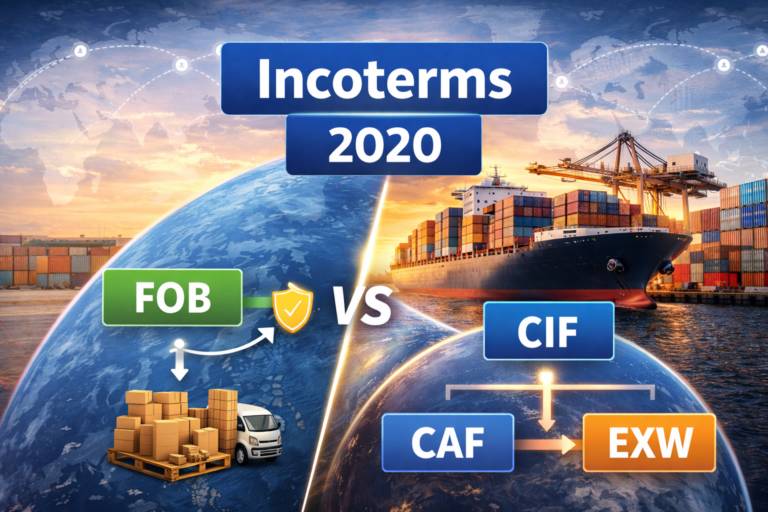
While there are 11 Incoterms 2020, South African importers must focus on three core terms that dominate our shipping lanes.
1. EXW (Ex Works): Simplicity for the Seller, Chaos for the Buyer
Under EXW, the seller’s obligation is minimal. They simply make the goods available at their factory or warehouse on the agreed date.
The Reality for the SA Importer: This is often the worst starting point for a growing business. As the buyer, you are responsible for everything that follows:
- Loading the goods onto the first truck.
- Arranging the export customs clearance and paying foreign duties in the seller’s country. (Finding a trustworthy foreign customs agent is difficult and expensive).
- Arranging pre-carriage, main transport, and final delivery.
If the truck crashes leaving the factory, the cargo loss is entirely your responsibility. We generally advise against EXW for small-to-medium South African importers.
2. FOB (Free On Board): The Strategic Ideal
This is the standard trade-off and the Incoterm we typically recommend for SA importers.
The seller is responsible for inland transport in their country, the export documentation, and loading the goods safely on board the vessel. The moment the goods “pass the ship’s rail,” the risk and cost transfer to you.
The Reality for the SA Importer: This rule gives you full control over the primary shipping leg. Because you (via your forwarder, 5 Seas Logistics) nominate the shipping line, you control:
- The Carrier Reliability: (Ensuring priority routing to Durban or Cape Town, as discussed in Topic 1).
- The Free Time: Negotiating better storage and detention windows.
- The Visibility: You are not dependent on a foreign seller to find out where your container is.
3. CIF (Cost, Insurance, and Freight): The Potentially Dangerous Convenience
This is the most popular, and simultaneously the most dangerous, Incoterm for inexperienced South African importers. The seller quotes you a single price that includes transport and marine insurance to your named destination port (e.g., CIF Cape Town).
It sounds convenient, but the danger is hidden in the technical requirements:
- Lowest-Quality Carrier: To maintain their profit, the seller will select the cheapest possible carrier, which often leads to slow transit times and maximum dwell time at congested SA ports (revisiting Topic 4).
- Minimal Insurance Cover: The 2020 rules for CIF only require the seller to obtain minimal insurance cover (ICC Clause C). This covers major events like a ship sinking but rarely covers common damage like water seepage, pilferage, or port handling accidents.
- Inaccessible Recourse: If your goods arrive damaged, you have to file an insurance claim with the foreign insurance provider chosen by the seller. Navigating a claim in a foreign language with a provider you did not choose is notoriously difficult and rarely leads to full reimbursement.
The 2 Seas Strategy: How We Audit Your Terms
At 5 Seas Logistics, we don’t just process freight bookings. We start by auditing your commercial invoice and quote at the point of negotiation.
Our team provides technical consultancy to determine which Incoterm serves your financial interest, balancing SARS compliance requirements (referencing Topic 2) with the economic predictability you need. In the chaotic operational landscape of South Africa, controlling the logistics via an FOB agreement is almost always the safer, more resilient strategy.
Conclusion
Incoterms are not a bureaucratic detail; they are the contract of carriage that defends your bottom line. Assuming that your international partner “is taking care of it” is not a strategy. It is a gamble with your inventory and your capital.
Don’t leave your trade terms to chance. Contact 5 Seas Logistics today, and let’s audit your standard purchase agreements to ensure they are serving your best interests.