In the high-stakes arena of agricultural exports, the margin for error is virtually zero. When you are moving premium perishable goods—whether it is export-grade citrus destined for the European Union, delicate deciduous stone fruit heading to the Middle East, or high-yield, grass-finished beef bound for Asian markets—a single degree of temperature deviation can wipe out an entire season’s profit margin.
South Africa remains a global heavyweight in premium agricultural exports. Yet, the journey from a rural packhouse in Limpopo or the Western Cape to a foreign supermarket shelf is fraught with infrastructural and regulatory hurdles. Protecting your biological assets requires far more than just a truck and a cold box; it demands a flawlessly executed, highly technical logistics strategy.
Beyond the Reefer: Active Cold Chain Management
A common misconception among emerging exporters is that booking a refrigerated container (reefer) guarantees product integrity. However, a reefer is designed to maintain temperature, not necessarily to dramatically lower the temperature of warm cargo.
True cold chain management is an active, unbroken discipline that begins long before the container doors are sealed.
- Precision Pre-Cooling: Agricultural products must be meticulously pre-cooled at the packhouse to their optimal transit temperature before being loaded. Loading ambient-temperature fruit into a reefer places immense strain on the container’s cooling unit, leading to uneven temperature distribution, “hot spots,” and premature ripening.
- The Unbroken Chain: The physical transfer of goods—from the cold store floor into the container—must happen in temperature-controlled loading bays. Any exposure to ambient South African summer temperatures, even for just a few minutes, can cause condensation on the product (sweating), which rapidly accelerates fungal decay during a three-week ocean voyage.
- Active Data Logging: Modern cold chain logistics relies on continuous, real-time visibility. We utilize advanced IoT (Internet of Things) data loggers placed strategically within the cargo. These devices do not just record temperature; they monitor humidity and CO2 levels, ensuring that the micro-climate inside the reefer remains perfectly stable across thousands of nautical miles.
Navigating PPECB and Phytosanitary Compliance
Exporting food from South Africa is a highly regulated, bureaucracy-heavy process. Foreign markets are incredibly protective of their own agricultural biomes and public health standards.
In South Africa, the absolute gatekeeper for perishable exports is the Perishable Products Export Control Board (PPECB). No agricultural product leaves the country without their authorization.
A strategic freight partner manages this complex bureaucratic layer for you, ensuring compliance at every step:
- PPECB Inspections: Coordinating mandatory inspections where officials verify that the product meets the stringent grading, packaging, and quality standards required for export.
- Phytosanitary Certificates: Working alongside the Department of Agriculture, Land Reform and Rural Development (DALRRD) to secure phytosanitary certificates. This document is your legal proof that the consignment is free from pests and diseases.
- Veterinary Health Certificates: For high-yield meat exports, securing the correct state veterinary approvals is critical. Any discrepancy in this paperwork will result in immediate cargo rejection and incineration at the destination port.
Cold Treatment Protocols for “Steri-Markets”
Certain lucrative international destinations, often referred to as “Steri-Markets” (such as the USA, China, and parts of the EU), enforce aggressive phytosanitary protocols to protect their local agriculture from invasive species like the False Codling Moth (FCM) or fruit fly, which are present in South African citrus and deciduous fruits.
For these markets, standard cooling is legally insufficient. Exporters must utilize specialized Cold Treatment (or Starcool) protocols.
Cold Treatment requires the core temperature of the fruit to be brought down to a highly specific, sustained low temperature (often around -0.5°C to 1.5°C) for a continuous, uninterrupted period (typically 22 to 24 days) during the ocean voyage.
This is not a mere quality guideline; it is a strict customs requirement. If the automated data loggers in the container register a temperature spike of even half a degree for a few hours, the treatment is deemed a failure. The destination country’s agricultural authorities will refuse entry, leaving the exporter with a catastrophic financial loss. Executing Cold Treatment requires precision logistics, flawless equipment, and a forwarder who understands the catastrophic financial stakes of a breached protocol.
Mitigating Infrastructure Risks: The South African Context
Executing a perfect cold chain is difficult under ideal conditions. Executing it within the current realities of South African infrastructure requires a masterclass in risk mitigation.
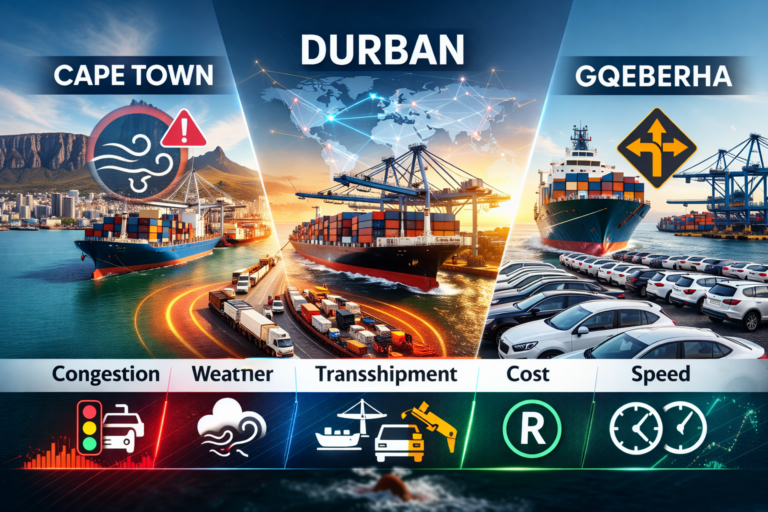
Agricultural exporters face a gauntlet of localized threats: severe port congestion at the Port of Durban, high-wind operational delays at the Port of Cape Town, and ongoing power grid instability across the country.
A proactive logistics partner doesn’t just hope for the best; they engineer redundancies into the supply chain:
- Gensets (Generator Sets) for Road Freight: When a reefer is loaded onto a truck for the long haul from a Mpumalanga farm to the Port of Durban, it cannot rely on the truck’s battery. We ensure the use of specialized clip-on gensets, which provide independent, uninterrupted power to the reefer unit, even if the truck is delayed for hours at a weighbridge or stuck in a backlog on the N3 highway.
- Port Plug-In Prioritization: When reefers arrive at the port terminal, they must be immediately plugged into the port’s power grid. We actively coordinate with terminal operators to ensure our clients’ containers are prioritized for power, mitigating the risk of temperature loss during extended stack-phase delays.
- Dynamic Rerouting: If Cape Town is facing a week-long wind delay during the peak table grape season, an agile forwarder will have the contingency plans in place to reroute cargo through Port Elizabeth (Gqeberha) or adapt sailing schedules to prevent the fruit from aging out of its optimal shelf-life window.
The 5 Seas Logistics Advantage
At 5 Seas Logistics, we understand that when we transport your agricultural exports, we are not just moving boxes—we are protecting your farm’s annual yield and preserving your reputation in the global market.
We combine deep physical infrastructure expertise with meticulous bureaucratic foresight. From managing PPECB inspections and ensuring flawless Cold Treatment compliance, to navigating the complexities of South African port congestion, we safeguard your perishable cargo from the packhouse to the final destination.
Don’t let a logistical blind spot compromise your harvest. Partner with the experts in South African temperature-controlled freight.
Preparing for the upcoming export season?
Contact the agricultural export team at 5 Seas Logistics today to audit your cold chain requirements and secure your temperature-controlled freight capacity.