For a South African entrepreneur, the moment your first international shipment departs for our shores is exhilarating. However, that excitement can quickly turn to anxiety when your cargo hits the “SARS Speedbump.”
Customs clearance is often viewed as a dark art of bureaucracy, but in reality, it is a precise science of documentation. At 5 Seas Logistics, we believe that transparency is the best tool for trade. This guide serves as your masterclass in South African customs compliance, ensuring your goods move from the port to your warehouse without unnecessary stops.
The “Why” Behind the Paperwork
Before diving into the “what,” it is crucial to understand the “why.” The South African Revenue Service (SARS) isn’t just looking for VAT and duty; they are responsible for national security, the protection of local industries, and the collection of vital trade statistics.
When your documentation is sloppy, it signals “high risk” to the SARS risk engine. A well-prepared document pack, conversely, signals a compliant, professional importer, often leading to faster processing and fewer physical examinations.
The Essential Document Stack: The “Big Four”
To clear customs in South Africa, you need a core set of documents. If any of these are missing or contain conflicting information, your shipment will stall.
1. The Commercial Invoice
This is the most critical document. It isn’t just a bill; it’s a legal declaration of value.
- Requirements: Must show the full names and addresses of both buyer and seller, a clear description of the goods, unit prices, total value, and the currency of sale.
- The Incoterm: It must clearly state the Incoterm (e.g., FOB, CIF, EXW). This tells SARS who is responsible for shipping and insurance costs, which impacts the “Added Tax Value” calculation.
Pro-Tip: Never use vague descriptions like “Parts” or “Samples.” Be specific: “Stainless Steel Grade 304 Industrial Bolts.”
2. The Packing List
The packing list mirrors the invoice but focuses on the physical nature of the shipment.
- Requirements: It must detail the number of packages, net and gross weight, and the dimensions of each pallet or carton.
- Accuracy: If SARS decides to weigh your container and the weight differs significantly from the packing list, it can trigger a full unpacking (detainment), which is both slow and expensive.
3. The Bill of Lading (BoL) or Air Waybill (AWB)
This is your “title” to the goods. It is issued by the carrier and serves as a contract of carriage.
- Function: It proves that the goods have been loaded and provides the instructions for where they are going and who can claim them.
4. Certificate of Origin (CoO)
This document proves where the goods were manufactured.
- Why it matters: South Africa has preferential trade agreements with the EU, UK, and SADC. A valid CoO can often reduce your duty rate from 15% or 20% down to 0%.
Common Pitfalls: The High Cost of Small Mistakes
New importers often fall into two dangerous traps that result in heavy fines or “Stop” notices:
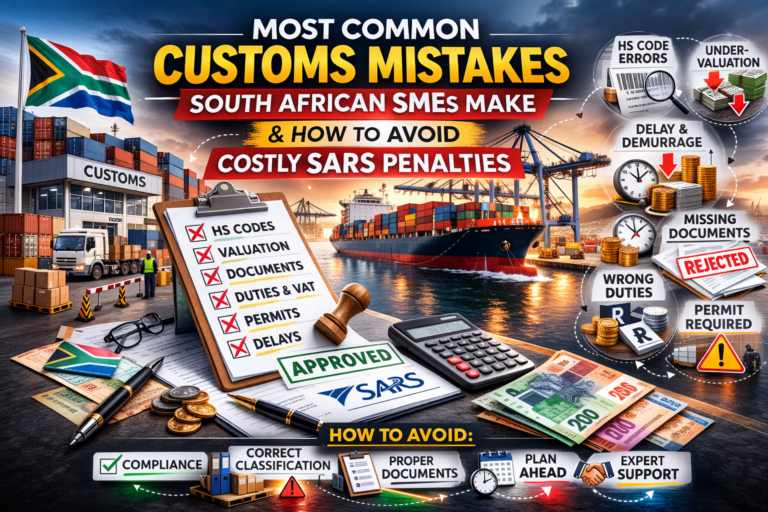
- Incorrect HS Code Classification: The Harmonized System (HS) code is a 10-digit number that tells SARS exactly what the product is. Picking a code with a lower duty rate might seem tempting, but “misclassification” is considered a serious offense.
- Value Under-declaration: Attempting to pay less VAT by asking a supplier to lower the invoice value is a red flag. SARS has a massive database of global commodity prices; if your “High-end Smartphones” are invoiced at $10 each, an audit is inevitable.
The 5 Seas Advantage: Your Compliance Buffer
Navigating SARS is about more than just filling out forms; it’s about managing the relationship between your business and the state. Our customs brokerage team acts as your front-line defense. We:
- Pre-Audit your documents before the ship arrives.
- Verify HS Codes to ensure you pay the legal minimum—and not a cent more.
- Manage Queries: If SARS asks a question, we answer it immediately with technical evidence, preventing a “query” from becoming a “stop.”
Your “Ready to Import” Checklist
Before you hit “Order” on that international shipment, tick these boxes:
- [ ] Importer Code: Do you have a valid SARS Importer’s Code? (Required for any commercial import over R50,000).
- [ ] Detailed Quote: Does your supplier’s quote include the specific Incoterm?
- [ ] HS Code Verification: Have you confirmed the duty rate for your specific product?
- [ ] Forwarding Partner: Have you sent your draft documents to 5 Seas Logistics for a compliance “health check”?
Pro-Tip: Always keep your customs records (digital and physical) for at least five years. SARS can conduct a “post-clearance audit” at any time, and you must be able to produce the original document trail.Conclusion
Customs clearance doesn’t have to be a roadblock. With the right documentation and a partner who understands the intricacies of the South African regulatory environment, you can turn your supply chain into a competitive advantage.
Don’t let your first shipment get stuck on the quay. Contact us today for a document review.